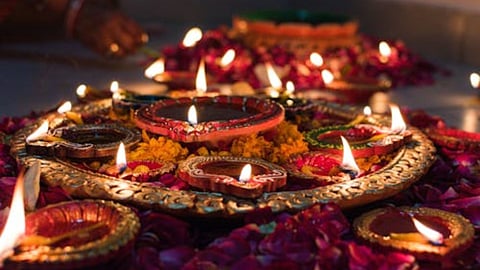

Diwali brings a breath of festive air to the month of October. But what’s interesting is how the festival is perceived and celebrated in the different regions of India. While one area of the nation enjoys the homecoming of Lord Ram after defeating Ravan, the festival holds different meanings for different people. It arrives with a distinct heartbeat in each region, different gods, different myths, different rituals and sometimes even an extra day or two of customs that many tend to miss out on. The festival is marked by different and often unique sets of rituals across India, and that is what makes this celebration rather special for Indians.
In much of the northern part of India, the third night of Diwali is celebrated as Laxmi puja, when families clean their homes and decorate it with rows of lighted diyas and candles, a ritual believed to invite prosperity into the home for the coming year.
However, the celebrations neither begin nor end there. The day before Laxmi Puja, many households observe Naraka Chaturdashi or Roop or Kali Chaudas, as called in several regions. A morning ritual where people take an oil bath at dawn, Naraka Chaturdashi is believed to spiritually cleanse one’s body and homes. This five-day celebration concludes with Bhai Dooj, a celebration of the relationship between brother and sister. The ritual includes sisters applying a tika on their brother and praying for their brother’s well-being.

In Gujarat, among many Marwari and business communities, the celebration of Diwali marks an accounting cycle called Chopda or Bahi-khata Pujan. During Diwali, merchants open fresh account books and worship existing ledgers with the different rituals that bless the year’s trade. Shops often resume regular business only after this puja. However, this is not it. The day after Diwali, in Gujarat, is celebrated as the New Year or Bestu Varas when people make fresh starts by buying salts, new utensils or exchanging sweets. This practice is believed to blend rituals with communal festivity.
While Gujarat celebrates Diwali like a fresh new beginning, the eastern part of India, in specific West Bengal, Diwali’s spotlight shifts from Lakshmi Puja to Kali Puja. During this Puja, the new-moon night becomes a time to celebrate Goddess Kali with large pandals and brightly lit lanterns, setting the festive tone. A noted similarity between the concluding rituals in the north and east is that Bengal also observes Bhai Phonta, a local form of Bhai Dooj. often marked the day after Kali Puja, Bhai Phonta is celebrated with a festive meal and ceremonial tilak.
In South India, it is common to have Diwali celebrations on the day of Naraka Chaturdashi instead of the night of Amavasya. The early morning oil bath is one of the characteristic customs here, similar to the rituals in Northern India. During the ritual, family members use scented oils and take ritual baths that are believed to be cleansing and protective against evil. In Tamil Nadu, Karthigai Deepam is celebrated at about the same time and with a similar spirit as Deepavali in the region. It is all about lighting oil lamps and in places such as Thiruvannamalai, lighting enormous fires on mountain tops making for a stunning and local representation of the light festival. The southern part of India has a different tempo for Diwali due to the focus on lamps, oil baths, and early-morning rites in comparison to the north.
Not just that, Diwali celebrations are particularly grand and a multi-day celebration when it comes to the agrarian communities of India. In various agricultural communities and devotional followers of Vaishnavism in northern and central India, the day following the festival of Diwali is observed as Govardhan Puja or Annakut. On this day, devotees prepare small hillocks made up of foodstuff, Annakuṭ, which means a heap of food, symbolising Krishna's lifting of the Govardhan Hill and thanking Mother Nature for her bounty. In certain western and southern states, the fourth day is also recognised as Balipratipada (Bali Padva), the day commemorating King Bali's yearly return; among the ways of observances are making images of Bali, having feasts and playing traditional games. These are all expressions of gratitude to earth, cows and the harvest that highlight Diwali's connection to agriculture.
India is home to diverse communities and cultures, and that is what makes the festivals here even grander. In Goa, Effigies and early-morning rites are conducted in several parts of the state. During the celebrations, effigies linked to the Narakasura story are burned at dawn; people then take scented oil baths and line their doors with lamps. This morning, theatricality is a strong local flourish.
The variety of practices reflects India’s diversity and the fabric of scriptures, local myths, caste-and-community histories, and agricultural calendars. Yet despite variety, there are common themes that bring people from different regions together in celebration of the light’s triumph over darkness.