
An Indian wedding is a stage that marks not just the union of a bride and groom but also signifies the importance siblings hold in each other's lives. From the Lajja Homam ceremony in South India to the Karma Sampati ritual of Maharashtra, Indian wedding customs and rituals highlight not just a marriage but an unbreakable sibling bond.
The universe of Indian weddings has always been an amalgamation of rituals and traditions, but when it comes to a Bengali wedding, it steers into an entirely new direction with a unique blend of customs and traditions. Bengali weddings and more specifically bridal entries have always been dramatic with cues from the cinematic world, with their visual drama that is quieter, deeply personal and entirely rooted in traditions and rituals that need no choreography to be unforgettable.
One such tradition in the Bengali weddings- Shubho Drishti- which translates to auspicious night, takes the relationship between a brother and sister beyond the ties of Rakshabandhan. The Shubho Drishti ritual in Bengali weddings shows that the brother’s promise of protection and lifelong support extends far beyond a festival. It is rooted in the biggest milestones in life.
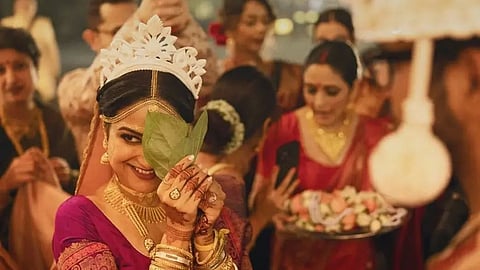
Shubho Drishti is a ceremony where the bride and groom lock eyes for the first time, but before the vows are taken and the sindoor is swept into the parting of the bride’s hair, a ritual signifying the sanctity of the moment is performed. The Bengali bride enters the wedding mandap seated demurely on a pidi-wooden stool, with her face hidden behind two betel leaves.

What happens next is what makes it an unforgettable ritual when her brothers carry the piddi and circle the groom seven times in slow, reverent loops, with each circle symbolising her entry into a new phase of life. It is only after these seven rounds that the bride is allowed to uncover her face and share her gaze or the Shubho Drishti- the sacred sight- with the groom. This moment marks her connection to her home and heritage, as her brothers gently guide her through the various chapters of her life, promising to be her support system, no matter how far life takes her. It is Rakshabandhan, but in motion, as the brother walks the bride to the threshold of her new life.
What makes Shubho Drishti truly significant is the role of the brother in the wedding. While most Indian weddings assign ceremonial duties to the parents of the bride or the elders in the family, this ritual regards the relationship and emotional connection siblings share. It signifies that the brother is not just a spectator as the bride moves into the next phase of her life, but is just as important as her father and is her guide, an anchor.
It represents a brother’s silent vow and the bride’s trust in him to walk her through this threshold into what awaits on the other side. And while Rakshabandhan is often about gestures of love and affection between siblings, this ritual has a deeper, ceremonial significance, with the brother’s role extending beyond gifting his sister a token of love to guiding her toward the biggest decision of her life.
An emotional moment, almost as theatrical as every ritual in Indian weddings, this ritual in Bengali weddings is subtle and unforgettable in every sense.
Luxury weddings today add a unique twist to every Indian tradition to suit their personality and make up for a unique experience. For brides who love a little twist to the tradition, Shubho Drishti offers the perfect canvas. From hand-embroidered Paan leaves or reimagined with filigree lace crafted into the drama of veils to the piddi elevated into a style statement, lacquered in jewel tones, hand-painted with family motifs or upholstered in brocade that matches the bridal palette, design houses are now crafting bespoke props to elevate this moment into heirlooms for generations.
Shuibho Drishti, at its core, is more than just a wedding ritual. It is an emotional pause, with a moment not just for the bride and groom but also for the bride and her brother, where time slows just enough for one sacred glance to say it all. At that moment, as the betel leaves fall and the bride meets the groom’s eyes, it is not just significant for the couple but also for the brother who lets go of his sister a little as she steps into a new world and begins her new life.