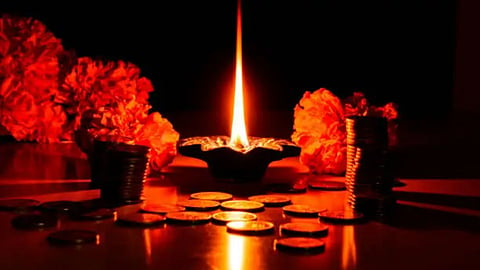

As the festive season begins with the onset of Dhanteras, everyone begins lighting a lamp in their homes. But one question that remains unanswered is why the lighting of lamps or diyas on a Dhanteras evening is considered important for the festivities and marks the beginning of the auspicious festival of Diwali. The small flame lighted on Dhanteras does not just reflect prosperity but something deeper.
Yamadeepam or Yama Deepam or in some regions Yamadeepdan, is a lamp lit for Lord Yama, the god of death. A ritual performed on Dhantrayodashi (Dhanteras) or the thirteenth day of Krishna Paksha in the month of Kartik, the Yamadeepam marks the beginning of the Diwali festival and serves as a symbolic prayer for protection, longevity and peace. Unlike the Lakshmi Puja which is usually associated with the festival of Dhanteras and emphasises on wealth, the Yamadeepam puja honours yama, acknowledging mortality and seeking safety before inviting abundance.
The origins of the ritual can be traced back to Hindu mythology and home rituals. One of the popular legends narrates the story of a smart young bride whose horoscope foretold that her husband was fated to die on the fourth day of their marriage. Determined to save him, she kept him awake through the night by lighting rows of diyas and spreading her ornaments and coins at the doorstep. When Yama arrived disguised as a serpent to claim the husband’s life, he was dazzled by the golden glow and unable to cross the threshold. By dawn, the appointed hour had passed, and her husband’s life was spared. This tale, which has been told for many years, became the mythic foundation for the Yamadeepam ceremony — a symbolic reminder that light, vigilance, and love can drive away the dark and the untimely death.
Beyond the legend, classical ritual texts call this particular observance Yamadipadana or Yamatarpan, part of a cluster of rites dedicated to appeasing Yama during the Diwali period. According to the traditional belief, Yama's energies are most powerful at the time of Trayodashi and providing light during the hour will help to soothe the forces. In a metaphorical sense, fire symbolises consciousness, a soul's presence that does not get extinguished even during the ups and downs of life. Hence, illuminating a lamp for Yama is not an expression of fear but gratitude and equilibrium, as it recognises death's certainty while still asking for its natural and timely course rather than a sudden end.

The ritual of the Yamadeepam is simple and takes place during the onset of dusk. During the sayam sandhya muhurat, people clean their houses— the threshold and altar— and prepare diyas made of often earthen clay or handcrafted from kneaded wheat flour mixed with a hint of turmeric. These lamps, according to the older texts, are then filled with ghee or oil and fitted with cotton wicks and are placed in the different corners of the house. In several houses, thirteen diyas are lit to symbolise the thirteenth day which are placed facing south— the direction ruled by Yama.
The diyas are usually placed outside the main entrance, in the courtyard and balconies creating a protective glow around the house. Flowers, sandal paste, turmeric, kumkum and rice grains are offered, and the first lamp is lit with a short invocation to Yamarāja to seek the safety and well-being of all family members. Some families recite brief Sanskrit verses, others offer a silent prayer. The diyas are left to burn into the night, their warm light considered a shield against accidents, illness and sudden misfortune.
In traditional households, the ritual of Yamadeepam is often accompanied by another ritual called Yamatarpan, the offering of water to Yama through copper vessels. This ritual is sometimes done by priests or elders. Together these acts serve as both purification and protection — symbolic gestures that balance the material and spiritual aspects of the Diwali season. While Lakshmi brings wealth, and Dhanvantari bestows health, it is Yama who ensures the continuity of life itself, and the Yamadeepam becomes the household’s votive for that safety.
The different regions of the country see the rite differently, according to the area and the local practice. People in the Northern part of India and Maharashtra mainly follow the tradition of thirteen lamps, whereas in the South, especially in Kerala and Tamil Nadu, the families usually light a single lamp facing south at the entrance, which is a part of their evening pujas. In traditional Gujarati households, rows of diyas might be placed on the veranda, but in the urban areas, people may often make the ritual simple—lighting one diya to signify the old pledge: to keep everyone inside safe from untimely death. However, while most parts of India still follow the traditional ritual, with changing lifestyles, LED diyas along with brass holders sometimes replace open flames, but the essence of Yamadeepam remains the same—it’s the purpose and acknowledgement that count, not the medium.
The ritual’s timing is considered crucial — always observed at twilight, just as the sky turns from gold to indigo. This transitional period symbolises the bridge between life and death, day and night, the known and the unseen. By lighting the Yama lamp in this in-between hour, families symbolically illuminate the path of life and request the divine to keep their loved ones safe through darkness. Many keep at least one diya burning through the night, continuing the light of protection until dawn.
Yamadeepam also possesses a soft philosophical beauty beyond its ritualistic aspect. During the festival of lights, when every lamp symbolises wealth and happiness, this one flame offers contemplation — a recognition that life, like a lit candle, is counterintuitive to its delicateness. Lighting the lamp for Yama signifies not only the fear of death but also the recognition of life, the acceptance of its limited duration, and the choice of consciousness rather than denial. It symbolises a balanced position — to recall death during festive times, to express gratitude with opulence.
Contemporary spiritual masters frequently view the ceremony as a metaphorical personal event — lighting the lamp of consciousness to dispel the darkness of ignorance and fear. Just like the physical diyas safeguard the homes, the inner flame guards the mind.