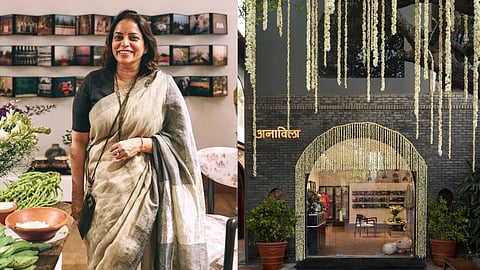

For over a decade, textile designer Anavila Misra has quietly reshaped the language of modern Indian fashion through linen, craft, and by lending a sense of ease to luxury. What began with the now-iconic linen sari has gradually evolved into a larger philosophy around dressing, one that values tactility, emotion, sustainability, and a deeper connection between the wearer and the garment.
At a time when bridal fashion is witnessing a noticeable shift away from overt grandeur and towards more intimate, textile-led expression, Anavila’s design language feels more relevant than ever. Brides today are seeking outfits that allow them to move, breathe, feel, and fully inhabit their celebrations. Comfort is no longer separate from luxury. In many ways, it has become central to it.
That sensibility also extends beyond clothing and into the brand’s newly unveiled Mehrauli flagship store, a sensory space shaped by craft, memory and earthiness. In fact, the store reflects the same philosophy that defines Anavila’s creations themselves: thoughtful, grounded, tactile, and deeply personal.
In conversation with Manifest, Misra reflects on textile making a way back in bridal dressing, the evolving relationship between craft and contemporary luxury, the future of Indian bridal fashion, and why she believes true beauty has less to do with transformation and more to do with becoming fully oneself.
Manifest: For years, bridal wear in India has largely been associated with embellishment and ornamentation. Do you feel we are now seeing a return to textile-led bridal dressing?
Anavila Misra: Yes, I do think there is a growing shift towards textile-led bridal dressing today, and the audience for it is far more expansive than it once was. What is driving this movement, is a deeper change in how young women are beginning to see themselves and their relationship to celebration, beauty, and the world around them.
These brides are often deeply self-aware. They are drawn to a kind of beauty that feels honest, and instinctive, rather than orchestrated. There is a comfort in their own skin, a lightness in the way they wish to show up on their wedding day. They want to move freely, dance, breathe, and truly experience the intimacy and joy of the occasion rather than feel weighed down by it. I also think this generation feels far more connected to nature and to the idea of living with greater awareness. The beauty they seek is quieter, and more authentic to who they are.
M: What is a bride looking for emotionally and aesthetically when she chooses Anavila for a wedding or a significant life moment? How would you describe an Anavila bride today?
AM: I would perhaps put it the other way around, the women who come to Anavila already possess a strong sense of self. They are comfortable in their own skin, confident in who they are, both privately and in the world around them. They are often thoughtful and curious people. They care about the way they live, travel, consume, and celebrate. There is an ease to them, and a certain individuality in the way they approach clothing and personal style.
I don’t think they are looking for something to complete them or transform them into someone else. They look for garments that resonate with who they already are, and that, to me, is very much the spirit of the Anavila bride today.
M: You once said your couture journey was less about occasion wear and more about intimate transitions and life phases. How does that philosophy translate into bridal wear?
AM: To me, bridal wear has never really been about dressing for spectacle but much more about how a person wants to feel in a moment which is extremely personal and transformative. The conversation then is not just limited to how they want to look but goes beyond it to who they are- what makes them feel most at ease, what they are drawn to instinctively and even their larger outlook on life. It then becomes about creating something that feels true to the person wearing it instead of imposing a singular aesthetic onto them. I feel this is what makes bridal wear meaningful when if reflects the inner life and individuality of the woman herself.

M: How have you reimagined linen and softer textiles for celebration dressing? Especially for summer weddings and intimate ceremonies.
AM: I think what is exciting for us is the play between linen and zari. There is this very interesting juxtaposition between the rough texture of linen and the sheen of zari, and what emerges from it has the wonderful beauty of an uncut diamond or burnished gold. It has this deep radiance which lights up a person’s being. And while it works beautifully for a celebration, it does not take away from comfort. That balance is very essential for me. It also becomes the perfect canvas for adornment and ornamentation, which is such an integral part of Indian dressing and aesthetic experience
M: There’s a noticeable shift towards comfort in luxury fashion right now. Can ease and grandeur coexist?
AM: Ease and grandeur have always coexisted in our country, in our landscapes, our textiles, our architecture, even in our ancient ways of living and dressing. There has never really been a separation between beauty and comfort in the Indian aesthetic imagination.
In fact, I don’t think luxury can truly exist without ease. To me, luxury is not excess or restriction; it is a certain effortlessness, a sense of harmony between the garment and the person wearing it. If something makes you feel uncomfortable or not yourself, then it begins to feel more like costume than clothing.
M: Your new Mehrauli store feels less like a retail space and more like an emotional, sensory world. What kind of experience did you want people, especially women shopping for milestone moments, to have when they walk in?
AM: I want the space to feel like a welcome respite, a place where women can arrive, pause and reconnect with themselves. Specially during milestone moments, there is already so much emotional and sensory overwhelm around us that I felt it was important to create an atmosphere of calm and ease. I want them take a breath, spend time with themselves, and engage with the garments sensorially, touch the fabric, feel its movement and observe how it responds to their body and to light. I want them to feel free to linger… and to twirl.
M: What colours, textures, or textile moods are exciting you right now for festive wear? Are there shades or weaving techniques you feel are defining the current moment in Indian fashion?
AM: Right now, I am particularly drawn to off-white and ivory. There is something very beautiful about their restraint. They allow light, jewellery, and movement to really come alive. As a canvas, they feel especially powerful for gold and silver, which are so intrinsic to our celebrations, where jewellery itself moves with the body. Alongside this, I am drawn to very distinct Indian tones like muddy reds, ochres, and even deep browns, they look beautiful when paired with zari. In terms of texture I always like it more subtle with motifs that are easy and intentional.
At a larger level, I feel there is a very interesting moment in Indian fashion where craft-led garments are moving beyond the sari into other silhouettes and so techniques on the loom are finding resonance globally. Techniques like Jamdani and Bandhani, long seen as heritage crafts, are now finding a contemporary international language through makers who are immersed and confident in the craft that they are working with rather than trying to make a statement for the international eye.
M: Your work often sits between revival and reinvention. When working with traditional embroideries, weaves, or techniques, how do you make them feel contemporary without losing their soul?
AM: In order to protect the soul of a craft technique, I think the starting point for me is always trying to understand how it is seen or percieved by the artisan. When we worked with Khatwa, for instance, we asked artisans to draw rather than giving them a vocabulary of our motifs. There is always a larger direction, of course, but when they draw, what emerges is very real; it reflects how they see a bird, a flower, or a form from their own lived lens. From there, we build the narrative forward. That process, for me, is what allows the work to feel contemporary without losing its essence. It is not imposed from the outside; it evolves from within the craft.
M: What do you think the future of Indian bridal fashion looks like over the next few years? Do you see it becoming more intimate, textile-driven, and emotionally rooted?
AM: This generation is beginning to approach weddings very differently. They continue to value beauty and craft, but there is a stronger desire for meaning and a clearer sense of self in what they wear. Bridal fashion, I feel, is moving closer to textiles and handcraft because these carry emotion and memory in a very human way. A textile ages with you, moves with you and that sense of lived-in authenticity is something people are increasingly drawn to. The idea of the “bridal look” is also softening. Instead of a singular, fixed image of the bride, there is a deeper focus on individuality—on personality and personal truth.
Brides are choosing garments that reflect their lives, their landscapes, their sensibilities, and their values, rather than conforming to a predefined idea of occasion dressing. In many ways, it feels like a shift from performance to experience.
M: What are you manifesting for the brand and yourself this year?
AM: Peace. A sense of calm. I want us to move slowly, with intention and to enjoy each moment of what we are making. And to let there be enough stillness to really see, feel, and appreciate what is being created as it comes alive.