
For years, Indian weddings have been defined by scale and opulence. Larger venues, taller floral installations, and extravagant décor became the formula for celebration. But a quieter shift is beginning to take shape across luxury weddings, one where storytelling is taking centre stage.
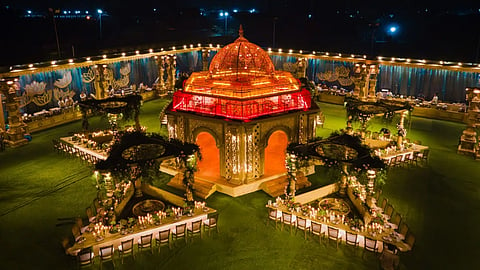
In Kolkata, experiential design studio Envelop recently unveiled Tattva: A Cosmic Story of Love, an immersive wedding reception concept that replaced traditional décor-led grandeur with a narrative universe brimming with emotion, movement, sound, and symbolism. Inspired by Panchabhuta, the ancient philosophy of the five eternal elements, the experience transformed the wedding reception into a sensory journey.
Rather than existing as a backdrop, the design itself became the storyteller.

Across luxury Indian weddings, there is a growing appetite for experiences that feel deeply personal rather than visually excessive. Couples are increasingly moving away from generic Pinterest-inspired aesthetics and towards celebrations that communicate identity, emotion, and memory.
Tattva feels like a reflection of this larger cultural shift.
Instead of approaching the reception as a singular visual party, Envelop conceptualised the event as a layered emotional journey unfolding across five distinct experiential realms: Vayu, Prithvi, Akash, Jal, and Agni. Each represented a stage in the evolution of love and partnership, drawing from the ancient Indian philosophy of Panchabhuta.
The progression began with Vayu, symbolising attraction and movement, before transitioning into the grounding energy of Prithvi, the openness of Akash, the emotional fluidity of Jal, and finally Agni, representing transformation and union.
The result was less “event decor” and more immersive world-building.
What set Tattva apart was its emphasis on atmosphere over ornamentation. The experience unfolded gradually as guests moved through the space, with lighting, textures, sound, spatial movement, and installations designed to evoke specific emotional states.
This multi-sensory approach signals where luxury weddings may be headed next. Instead of static beauty, designers are now exploring how guests can feel a celebration.
Music also became central to storytelling. Performances by singers including Arijit Singh, Sonu Nigam, Rahul Vaidya, and Stebin Ben were woven into the elemental narrative, making sound become a part of the design language and the overall experience.
For years, conversations around Indian weddings have largely centred around maximalism. But concepts like Tattva suggest that the future of luxury celebrations may lie in intentionality rather than the grandeur.
Even visually, the experience leaned into surrealism and emotional symbolism over conventional wedding cues. Instead of relying solely on florals or opulence, the design vocabulary drew from cosmic imagery, elemental philosophy, and spatial storytelling.
This also reflects a broader evolution in wedding aesthetics globally, where experiential hospitality, emotional resonance, and cinematic environments are becoming more important to modern couples.
At Tattva, guests were not merely attendees at a reception. They became participants moving through chapters of a story.
Tattva points towards a future where weddings are designed less like events and more like immersive narratives. Because increasingly, luxury is no longer just about how grand a wedding looks. It is about how it makes people feel.