
If you’ve spent even one weekend navigating winter wedding invites, you’ll know how quickly the conversation turns to food. And here, in India, the wedding season and winter arrive almost hand in hand. As the air turns cooler, invitations pile up, travel plans take shape, and conversations begin to orbit around food almost instinctively. And we Indians take our food very seriously.
From the smell of charcoal drifting from a tandoor, the comfort of hot naans brushed with butter, kebabs and tikkas eaten standing up between conversations, to that inevitable pause for dessert when someone mentions gajar ka halwa. Winter sharpens appetites and memories. And weddings, which already place food at the centre of celebration, amplify that instinct even further.
Indian weddings have always paid serious attention to what is served. But in recent years, couples have begun to focus on menus that feel seasonal, personal, and considered. Winter, with its abundance of produce and slower rhythms of cooking, has become the season where this shift feels most natural.
Chefs agree that colder months change not just what people want to eat, but how they experience food. According to Chef Harpal Singh Sokhi of Karigari, winter food carries a deeper emotional weight. “Winter is when food feels most emotional,” he says. Ingredients like kali gaajar, sarson, shakarkandi, singhade, methi and bathua are at their best during this time, and people instantly relate to them. “For weddings, dishes like Sarson ka Saag or a Kali Gaajar ka Halwa work beautifully because they feel festive without being forced. They carry warmth and a sense of abundance, which is exactly what guests expect at a winter celebration.”
That sense of abundance, chefs say, does not come from excess, but from familiarity and patience. While developing Karigari’s winter menu, Chef Harpal intentionally returned to slower, more traditional methods of cooking. Halwas that cook overnight, saag simmered for hours, and dishes like Amritsari paya prepared the way they were always meant to be. Ingredients such as shalgam, bathua and even zakhia seeds, once winter staples, have largely disappeared from large-format menus. Their return reflects a broader shift. “Weddings are moving towards more thoughtful food,” he explains. “These traditional methods and ingredients naturally fit into that shift.”

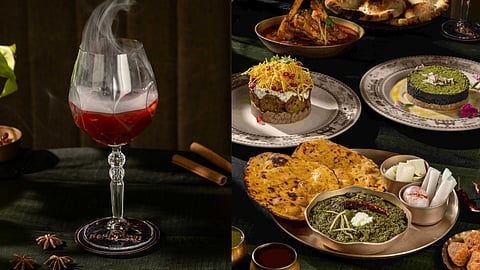
If winter had to be translated into a wedding tasting menu, Chef Harpal’s choices are revealing. He would begin with singhade and shakarkandi chaat, lively and chatpata enough to open the meal on a festive note. The main course would centre on sarson ka saag with masala makai paratha, a dish that, as he puts it, “represents winter in North India and comes straight from the kitchens of my homeland.” Dessert would be kali gaajar ka halwa with panjiri, rich, comforting, and unmistakably seasonal.
Legacy restaurants are also shaping how winter wedding menus are being reimagined. At Daryaganj, known for inventing Butter Chicken and Dal Makhani, seasonality is not treated as a trend, but as a return to fundamentals. “For us, the legacy is non-negotiable,” says Amit Bagga, Co-founder, CEO and CMO of Daryaganj Hospitality. “The core recipes, the technique, the sequencing, the flavour profile remain exactly as they were meant to be. That is the soul of Daryaganj. What evolves is the context around it.”
Bagga explains that today’s diners are looking for experiences rather than just dishes. Seasonal menus allow restaurants to highlight ingredients and techniques that were always part of Indian cooking but gradually faded from public dining. “In many ways, we are not modernising the food, we are restoring it,” he says. The evolution happens in how the overall dining experience is curated, without disturbing the integrity of the recipes themselves.
This philosophy translates seamlessly into winter weddings. According to Bagga, classic North Indian winter dishes are no longer being treated as nostalgic add-ons. “There is a clear shift where people are proudly placing regional and seasonal food at the centre of celebrations,” he says. Sarson ka saag and makki ki roti are increasingly becoming statement dishes rather than sentimental gestures. “When served correctly with white butter, jaggery and traditional accompaniments, they carry both emotion and gravitas.” For hosts who want weddings to feel personal rather than generic, seasonal food becomes one of the most meaningful expressions of that intent.
Interestingly, this return to slow cooking and traditional techniques is resonating strongly with younger audiences as well. “Younger diners are surprisingly drawn to things that feel real and unhurried,” Bagga notes. In a fast, digital world, food that takes time offers a sense of grounding. “What we are seeing is not nostalgia for the past, but respect for it.”
That sentiment is echoed by Deep Chand Dobriyal, Brand Chef at Daryaganj, who points out that winter greens are uniquely suited to celebratory meals. Sarson, methi and bathua have strong personalities and cannot be rushed. “When slow-cooked, they mellow out and develop layers of flavour that pair perfectly with butter, ghee, cornmeal and earthy spices,” he explains. Traditionally, these ingredients were eaten in winter not just for taste, but for nourishment. “They sustain you, and that sense of comfort is exactly what people look for during celebrations.”
Winter also changes how chefs think about texture and spice. According to Dobriyal, the focus shifts towards softness, richness and depth. Slow cooking becomes central, spices are used for warmth rather than heat, and fats like butter and ghee play a more prominent role. “The goal is indulgence, but without excess,” he says. “A good winter dish should make you feel full and content, not heavy. That balance comes only from technique and patience.”
Taken together, these perspectives point to a clear conclusion. The perfect winter wedding menu today is not about novelty or scale. It is about seasonality, memory and care. It celebrates ingredients at their peak, honours time-tested methods, and understands that the most memorable wedding meals are often the ones that feel deeply familiar.
In a season defined by cold evenings and long celebrations, winter wedding food is finally doing what it has always done best: bringing people together, one warm plate at a time.