
Eric Chopra Decodes The Many Shades of Romance in Indian Paintings

Itihāsology’s Eric Chopra decodes five beautiful medieval artworks that explore the theme of love and longing.

Jan 9, 2026
By Eric Chopra
  • Sakhi Persuades Radha to Meet Krishna
    Love is in the ArtThe Cleveland Museum of Art

    One of the recurrent themes in medieval Indian paintings, from the Pahari hills to the Deccan courts, is love and the many emotions it carries. These works capture the entire spectrum: yearning, viraha, reunion, quarrels, surrender, and even the loss of self in pursuit of the beloved. At times, love is elevated into the language of devotion. The scenes range from archetypal nayaks and nayikas to stories of Radha and Krishna, Layla and Majnun, and Nur Jahan and Jahangir. Rich in rasa (flavour, sentiment), these paintings invite us to become rasikas, connoisseurs of their lyricism.

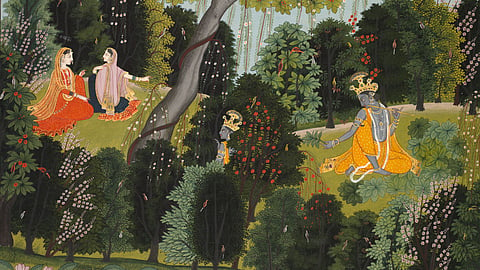
    Sakhi Persuades Radha to Meet Krishna by Purkhu, 1820-25, Kangra

    Sakhi Persuades Radha to Meet Krishna (1)
    Sakhi Persuades Radha to Meet Krishna The Cleveland Museum of Art

    This painting channels the emotional intensity of Jayadeva’s Gita Govinda, the 12th-century Sanskrit masterpiece devoted entirely to Radha and Krishna. The poem captures viraha-dukha, the pain of separation in love. In this painting, Radha sits in hesitation as her sakhi gestures, urging her to go. The friend is essential: confidante, keeper of secrets, the one who bears sorrows and inconvenient thoughts alike. On the right, Krishna appears twice. First, he peers anxiously from behind the bushes; then, in another moment, he sits with his flute, restless and waiting. The melodies of the flute carry Radha’s name.

    Escapade at Night by Chokha, 1800-10, Mewar

    Escapade at night
    Escapade at nightThe Metropolitan Museum Of Art

    This artwork (above) is charged with the thrill of secrecy. The palace sleeps: guards slumber at their posts, a noblewoman drifts in reverie, and amidst it all, there is a clandestine moment. Outside, a richly adorned horse waits as its master scales a rope towards his beloved, who leans from the jharoka. Animals gather below in pairs—monkeys, rabbits, birds—and seem to be the only witnesses to the union. Above them, storm clouds roil. The lover braves danger and weather to reach his beloved, a theme that recalls the archetype of the Abhisarika Nayika, the heroine who dares the night for love.

    Raja with His Beloved, 1790-1800, Kangra

    Raja and his beloved (1)
    Raja with His Beloved, 1790-1800, KangraThe Cleveland Museum Of Art

    In this Kangra scene, paan once again marks intimacy. The Raja and his beloved sit on a terrace bed, eyes locked, bodies cradled into each other. He reaches delicately into a paan-daani, while she holds a leaf near his lips. Around them, seven attendants perform their duties—fanning, blushing, bearing perfumes, carrying trays—but they appear as silent shadows to the lovers. The painting epitomises the surrender of self in love: to be so absorbed in one another that surroundings dissolve, that one’s identity drips into the other’s like a drop into the ocean.

    Nur Jahan Holding a Portrait of Jahangir by Bishan Das, 1627, Mughal

    Nur Jahan Holding a Portrait of Jahangir by Bishan Das (1)
    Nur Jahan Holding a Portrait of Jahangir by Bishan Das, 627, MughalThe Cleveland Museum Of Art

    This painting, of Nur Jahan holding a portrait of her late husband Jahangir is both political and personal. For centuries, she was cast in history as a schemer who usurped power, a reading shaped by patriarchal suspicion of female authority. Today, we understand Nur Jahan and Jahangir as cosovereigns, partners in governance and in love. The composition harks back to Mughal allegories: Jahangir once held a portrait of Akbar after a dream visitation. Here, Nur Jahan cradles Jahangir’s image, haloed and gazing out from a jharoka. Her attire, a skirt of diaphanous muslin—that famed textile likened to evening dew (shabnam), sometimes called baft hawa, ‘woven out of air’. Born Mehrunissa, she was first titled Nur Mahal (Light of the Palace), but soon, with her radiance shining the entire universe, she was renamed Nur Jahan (Light of the World).

    Two Young Men Seated, One Offering the Other Paan, Early 18th century, Pahari

    Two Young Men Seated, One Offering the Other Paan
    Two Young Men Seated, One Offering the Other PaanMuseum of Fine Arts, Boston

    Among the Pahari paintings, this intimate scene (left) is most tender. Against a plain maroon backdrop, with its starkness heightening privacy, two men sit locked in an unwavering gaze. A paan-daani rests before them, filled with betel leaves. In their hands, more leaves lie in waiting: two poised on laps, one raised as an offering. The man on the left reaches to feed his companion, but his wrist is restrained gently by the other, who seems to want to reverse the gesture. The paan, long a motif of love, here symbolises both union and parting. Mir Taqi Mir once wrote, in Saleem Kidwai’s translation: “When hair appears on your face, my dear, you will learn kindness. Helplessly you will offer your lovers betel leaves as tokens of parting.”

    - Avarna Jain,
    Chairperson RPSG Lifestyle Media

    For Manifest to become one of Cambridge Dictionary's most viewed words of 2024 — 1,30,000 hits and counting — it means some of us must have Googled it at least once. I know, I hit that search button over and over again
    because each time I looked at it, I saw a new meaning.

    - Avarna Jain,
    Chairperson RPSG Lifestyle Media

    Putting together a homegrown title at a time when the demise of print has been long announced may seem surprising...
    ...but it has long been a dream of mine to give India a magazine it deserves. A magazine that is the country.

    - Avarna Jain,
    Chairperson RPSG Lifestyle Media

    And nothing, absolutely nothing, represents India more than our weddings.It is a time when families are brought together. Traditions come alive as they are adapted to each couple's beliefs. And lives are joined in a way that the romantic in me still enjoys.

    - Avarna Jain,
    Chairperson RPSG Lifestyle Media

    The fact that it comes with band, baaja and baraat — what's not to love?And that is the reason our first issue celebrates:
    THE NEW BRIDE.

    - Avarna Jain,
    Chairperson RPSG Lifestyle Media

    If you look at
    'Curate Beautiful, Create Happy'individually, they are powerful but when you put them together, they become a promise. While each section is dedicated to a word, I hope you will see this as your first of many handbooks for happiness.

    - Avarna Jain,
    Chairperson RPSG Lifestyle Media

    Curate
    Where we give you a fast-paced look into everything you should wish list when you start to think about marriage. What to buy and how to dress, along with modern mithai and the homegrown fragrance makers to bookmark. Make special note of the feature on alta.

    - Avarna Jain,
    Chairperson RPSG Lifestyle Media

    Beautiful
    It has everything you need to make your wedding special. From the big comeback of red and pink in bridal wear to how the cool kids are wearing corsets to the celebration, there is only one way to get ready for a wedding —with enjoyment.

    - Avarna Jain,
    Chairperson RPSG Lifestyle Media

    Create
    This section is a building block, a step to a better life. A place where we have all the answers. Or at least the beginning of a great conversation.

    - Avarna Jain,
    Chairperson RPSG Lifestyle Media

    Happy
    This needs very little description. It has travel with a special focus on incredible India, and a collection of wedding albums, sourced randomly, but collected with abundance because happiness has no limits.

    - Avarna Jain,
    Chairperson RPSG Lifestyle Media

    This first issue has a lot more, including a carefully edited address book of everything you need to make your wedding perfectly 'gramworthy! But it doesn't stop there. Each issue will be different because each one of you is unique.
    Because we manifested this difference, now we will celebrate you.

    - Avarna Jain,
    Chairperson RPSG Lifestyle Media