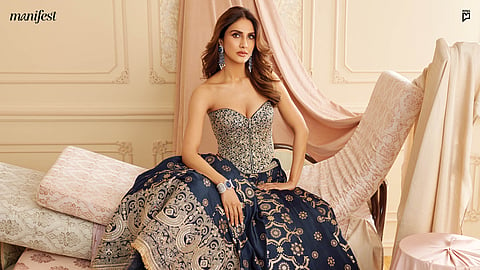

Vaani Kapoor arrives on set with off her OTT debut—a project she admits came with its own nerves and thrills—she’s been criss-crossing cities for promotions, fielding flights, fittings, and film sets. Yet, there’s no trace of fatigue in her voice, only grounded warmth.
We settle into conversation, and she reflects on nearly 12 years in cinema. “I’ve only become hungrier and greedier for better work,” she says candidly. “Some actors reach a point where they pick and choose; for me, it’s been a slower, steady growth. I feel like I’m still at the stage where projects choose me. Whatever comes my way, I try to make it distinctive—at least within my bandwidth. Every role has taught me something.”

She frames her career as a slow, deliberate arc. The growth has been real, but not always easy. There are moments she questions herself, goes through reviews to understand “where could I have been better”, and, when it becomes necessary, she learns to block the noise. What worries Vaani is how quickly opinions travel now. “Words hold more power…it’s not just actors anymore—influencers, podcasters, reviewers, they all are shaping public perception,” she observes, mindful of the responsibility that comes with moulding narratives for wide, impressionable audiences. Still, Vaani considers a healthy critique and keeps recalibrating. “I am constantly striving to be better at my job. I take the feedback, I learn from it, and I grow from it.”
Vaani’s hunger for varied characters explains why she took on certain challenging parts, too. When I ask, out of the many personas she’s portrayed on-screen, which role lingers the longest, she immediately responds that each has been special because she pours her heart into it. Be it a role that felt distinctly French in its outlook (as Shyra in Befikre, 2016) to her sensitive portrayal of Manu or Maanvi in Chandigarh Kare Aashiqui (2021), and the cool detachment of her latest character in Mandala Murders (2025).
“For me, playing Manu in Chandigarh Kare Aashiqui was a very new territory—I’ve not walked a mile in the shoes of a trans woman, and playing that character felt so empowering,” Vaani tells us. But the films that fed the idea of love for her were the old-school romances—the Yash Raj [Films] kind of cinema that made romance feel “larger than life”. “Even as a little girl, I always found myself falling in love with the idea of love through movies. I’d watch a scene brimming with emotion, where two people could completely surrender to that feeling—something inside me would light up. I wasn’t just watching it, I was breathing it with those characters.”
That appetite for big emotion fuels the kind of stories she’s drawn to —tales of pure love. And films that restore her faith in it are deeply valuable to Vaani. “You know, the love stories that explore the dynamics of any relationship, they intrigue me a lot. Because we all are so different from one another, with different traits…so it is important to step into their shoes to understand them.”
If cinema shaped the way she imagines love, love influenced the way Vaani imagines life. “I am a big believer in love. Love is what makes the world go round. It’s as important as breathing for me… you just can’t survive without this emotion.” She adds, “I am a huge fan of Hindi cinema, and it has been my escape. Whenever I feel like I am in the midst of a challenging situation, I watch a feel-good movie, and life immediately seems better. So, that fulfilment is what I chase through films, romantic films especially.”
It is clear that Vaani is unabashedly romantic and believes in the ‘fairytale romance’.
But when asked to define what love truly means to her…she is at a loss for words. “I don't feel like defining it, because love doesn’t feel like an emotion that can be summed up in words. As I mentioned earlier, to me, it is like breathing. You can’t live without love, it is essential for our existence and happiness. Ultimately, we are all chasing happiness. There are times when I feel a dearth of self-love, and that’s the time I feel—and know—that I need to give more of it. I believe the more love you are capable of giving, it will come back to you multifold.”
When the conversation turns to how she shows up in relationships, Vaani becomes reflective. “I love giving…it truly brings me a lot of joy. As long as my basics, non-negotiables are met—respect, love, thoughtfulness—it’s fine. There are relationships where one person gives and the other only takes...you don’t want to be taken for granted like that.” Reciprocity, she says, is essential. And Vaani is not someone who seeks grand gestures from her partner. “It’s the small, mindful things that show true intention. It can be heartening if somebody goes out of their way, but the little things that a person remembers—that someone is seen, heard or respected—those are even grander.”
And in a partner, the non-negotiables are clear: “Emotional maturity is extremely important for me…someone who can make you feel seen, heard, and respected. Respect is where love speaks for me. I am also a loyal person—loyalty is my very core.”
All this talk about love, and our conversation naturally steers towards weddings. Interestingly, weddings occupy a practical corner of Vaani’s heart. Her earliest memory is of her sister’s wedding, when Vaani was only 15-years-old, and the odd ache of watching someone you love move away. That memory taught her something early: she wasn’t obsessed with weddings as a ‘spectacle’. “I’ve always wanted to make something of myself and only marry when I felt the moment was right—being mentally prepared matters more.” If she found the right person, she’d be happy to marry at her own home, minus the grandeur one associates Indian weddings with.
In the next moment, Vaani shares something deeply sensible, yet poetically meaningful: “I am more interested in the ‘after’—the life that unfolds together, rather than the excitement of what that one day would look like.” Yet she admits to the occasional fantasy of a palace wedding in Rajasthan—the drama of forts and palaces still appeals in a fleeting, romantic way.
When prodded on her bridal style, Vaani reflects for a moment, and shares, “I see myself as a traditional bride—at least, on the day of the wedding, I want to be dressed like an Indian bride…fairly traditional.” And the name she drops when asked about designers is Manish Malhotra: “I absolutely adore Manish Malhotra, not just because he’s a phenomenal designer, but because he’s a great human being—grounded, humble and kind.”
Vaani’s off-duty look is almost the opposite of bridal grandeur:. Vaani laughs about turning into a jeans-and-T-shirt girl after moving to Mumbai. “In Delhi, I used to dress up a lot. I was modelling at the time, so I had to look well put together. But, in Mumbai, I live in monotones—whites, blacks, beiges—with jeans and chappals.” For her, comfort dressing reigns supreme, with occasional, considered leaps into experimentation.
As we chat some more, I am compelled to ask who the real Vaani is. Her films may have shaped the public’s perception about Vaani, but there is a side to her that only people closest to her are privy to. She tells me she is “guarded and shy”. “I can be very funny, I can literally dance around like a cartoon, but that side is for the people I’m comfortable with. I take time to open up.” Strength, for Vaani, comes from holding on to self-belief even in doubt. “The most successful people aren’t the ones who’ve never failed…
They’re the ones who don’t quit. I’ve come to a point where I’ve stopped seeking validation from those who don’t believe in me.”
Vaani has learned to set boundaries for mental peace and to parse criticism—to accept constructive, respectful responses, and to resist bandwagons of negativity. She returns to the responsibility of speech in a digital age: “Words shape narratives. You need to choose your words wisely and have more kindness.”
Finally, to her younger self, she offers a single, sustaining counsel: hold on. “There has been a consistent inner voice…sometimes everything can go against you, but then you don't quit because something within you says, ‘Hold on, hold on to your belief.’” The sentence trails into the hopeful hush of someone who still believes that faith, like talent, is something you cultivate patiently.
On a lighter note, we discuss how astrology has taken over our lives today. Her take on that is playful, but measured. Vaani is open to it, but “in phases, out of fun”. “I believe in free will, but yes, destiny also has a role to play.” She gives an example of a friend of hers who knows astrology and read her chart. “I was told the last few years might not have been the best for me, yet I found opportunities with good filmmakers.” That, for her, is proof that both elements—fate and choice—matter.
We leave the conversation feeling like we’ve been given a small map of what matters to her: growth over glamour, love over spectacle, and a steady, modest devotion to the small acts that make life—and, perhaps, marriage—worth living.
Photographs by Taras Taraporvala; Styling by Who Wore What When; Make-up: Tanvi Chemburkar; Hair: Sangeeta Hegde; Set Director: Jahanvi Patwardhan; Production: P Productions; Bookings Editor: Varun Shah
This story appears in Manifest India’s Issue 04. Subscribe here for more stories like this.