Mogra is a flower synonymous with purity, beauty, and love. The heavenly aroma of these delicate little flowers is up there with the aroma of the wet soil after it rains. Not only is it a breathtakingly beautiful flower, but it also holds a deep meaning. Mogras symbolise purity, divinity and spiritual awakening.

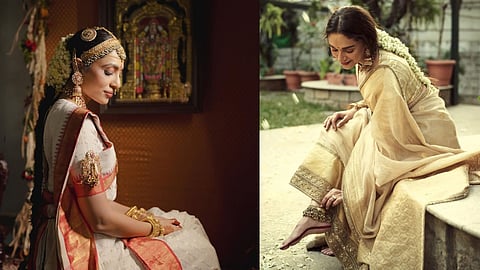
A gajra, or a string of mogras or jasmine flowers is also one of the steps in the Solah Shringar, or the 16 adornments that a married Hindu woman should wear. Mogras are often associated with grace, elegance, and femininity, and a bride wearing Mogras in her hair is a way of hoping for her to embody these traits.
Mogras hold a deep spiritual significance as well. It is believed that Kamadeva, the Hindu God of love, had five arrows, each of them tipped with a different flower, and these arrows are said to evoke feelings of love. Sure enough, one of these flowers is believed to be Jasmine. Jasmine flowers, being considered auspicious and sacred, are also offered in pujas and in temples. Additionally, it is also believed that Jasmine is one of the flowers that Goddess Lakshmi loves, so it is often associated with prosperity and auspiciousness.
It is common for South Indian women, especially brides, to wear Gajras in their hair, whether wrapped around a bun, or wrapped around their braids. Although it isn’t as common for North Indian brides to wear Mogras in their hair, maybe they should also consider getting on the Mogra bandwagon given the deep cultural and spiritual significance that they hold. Symbolism aside, they are very beautiful, and can add a really dreamy, old-school feel to a bride’s look. We would particularly suggest hopping on the Gajra hype train for a day wedding, or pre-wedding festivities. Granted that a typical Hindu wedding lasts for several hours, and keeping Mogras fresh for long can be challenging, so wearing Mogras for festivities like mehendi or haldi is a great choice!
You can choose to incorporate Mogras in your hair however you want. The sky's the limit! You can take the traditional route and wear them in your hair, around a bun or braid, or you can wear jewellery made entirely out of Mogras for your haldi—maangtikka, bangles, earrings, even anklets made out of Mogras. Or, if you want to go one step further, you can wear Kaliras made with Mogras at your wedding! Go all out!