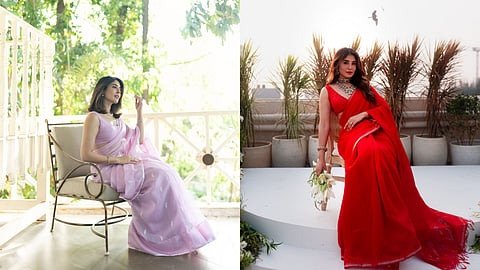
Kritika Kamra’s wedding wardrobe brought together two very different expressions of fashion. For her signing ceremony, the actor wore a handwoven Chanderi sari designed by her mother for their label Cinnabar and crafted by the brand’s artisans. For her reception, she chose an archival Dior gown by the legendary designer John Galliano. What connected the two was a shared appreciation for history, craftsmanship and pieces that can live beyond a single occasion.
The same idea of giving fashion a life beyond the moment sits at the heart of Manifest’s August theme, Threads of Tradition, which explores real brides who have brought family textiles, heirlooms and traditions into their wedding wardrobes, either by carrying something forward or creating a new heirloom of their own.
For Kritika Kamra, this extends beyond her wedding. As the co-founder of Cinnabar, she works with the women artisans of Chanderi in Madhya Pradesh to support the region’s handloom tradition and make the craft relevant to a contemporary wardrobe.

On National Handloom Day and the launch of Cinnabar’s new festive capsule, Tarang, Kamra speaks to Manifest about her wedding saree, why handloom needs aspiration rather than sympathy, the growing interest in archival fashion and what it means to wear something with a story.
Manifest: You got married to Gaurav Kapur in March. Tell us a little about the wedding and the Indian textiles and silhouettes you chose across the celebrations.
Kritika Kamra: Our wedding was a reflection of who we are as a couple. We wanted it to feel intimate, warm and rooted in the things that matter to us, rather than driven by spectacle.
That philosophy naturally extended to what we wore. For the signing ceremony, I wore a handwoven Chanderi sari from Cinnabar that was designed by my mother and crafted by our artisans.
For the after-party style reception, I wore an archival Dior gown by John Galliano. On paper, they couldn’t be more different, but to me, they were connected by the same idea.
Both celebrated craftsmanship, history and clothes that carry meaning beyond the moment.
(M) For one of your wedding looks, you wore a red sari from your mother’s label, Cinnabar. What made this particular sari feel right for such an important moment, and what does wearing something from your mother’s creative journey mean to you?
(KK) It never felt like a decision I had to make. It was always going to be Cinnabar.
My mother and I built Cinnabar together, so wearing it on my wedding day was particularly meaningful. The sari was designed by my mother and woven in pure Chanderi silk with real zari by our artisans. It took many weeks to make, and every detail reflected the care and craftsmanship that went into creating it.
I also loved the symbolism of the red. It felt timeless, classic and completely true to who I am. Looking back, I can’t imagine wearing anything else.
(M) Did you also incorporate any heirloom pieces from your family wardrobe into your wedding? If so, tell us about the piece, who it belonged to and the memories attached to it.
(KK) No, I didn’t. The Cinnabar sari itself felt like the heirloom I wanted to create. I hope it’s something that gathers meaning with every passing year and is eventually passed on with stories of its own.
(M) Your wedding wardrobe had a distinctly understated approach to Indian dressing. What draws you towards the simplicity and craftsmanship of handloom and traditional Indian textiles?
(KK) I think the most elegant clothes are often the ones that feel the least forced. I’ve always loved Indian textiles because they have an ease about them. They have character, texture and depth without ever feeling excessive.
That’s the kind of dressing I’m drawn to. Pieces that feel timeless rather than trend-led and become more meaningful the longer you live with them.
(M) You also run a sustainable fashion brand that works with the women of Chanderi to support and preserve the region’s centuries-old handloom tradition. How has your connection to Chanderi shaped your relationship with textiles and fashion?
(KK) My connection to Chanderi has given me a much greater appreciation for what it really takes to create something beautiful. When you spend time with the artisans, you begin to understand that every sari is the result of extraordinary skill, patience and generations of knowledge.
Building Cinnabar has made me realise that preserving a craft isn’t just about preserving a technique. It’s about creating opportunities for the people who keep that tradition alive by ensuring their work continues to be valued, worn and celebrated.
(M) With National Handloom Day coming up on August 7, what do you think we need to do to make handloom more relevant and desirable to a new generation of consumers? What role can fashion play in keeping these traditions alive?
(KK) I don’t think handloom needs sympathy. It needs aspiration. People have to genuinely want to wear them, not because they feel they should, but because they feel relevant to the way they live and dress today.
That’s where fashion has an important role to play. Good design, thoughtful storytelling and contemporary styling can introduce handloom to a new generation without compromising the integrity of the craft. The more we wear it as part of our everyday lives and celebrations, the more we ensure these traditions continue to thrive.
(M) You chose an archival John Galliano gown for your reception. We are seeing a growing number of brides turn to archival fashion and vintage pieces for their wedding celebrations. Why do you think this is happening, and could archival dressing be the new way of embracing the idea of being an ‘heirloom bride’?
(KK) I think people are looking for pieces with a point of view rather than just something new. I chose an archival Dior by John Galliano gown because I’ve always admired his work. If you’ve studied design, Galliano is someone you inevitably come back to. His years at Dior produced some of the most extraordinary collections in fashion, and his understanding of the bias cut and the way he sculpted the body is unmatched.
I also think we’re only just beginning to embrace archival fashion in India. We’ve always valued heirloom jewellery and handwoven textiles, but not necessarily archival designer fashion in the same way. That’s beginning to change, and I think it’s exciting because it encourages us to see great fashion as something to be collected, preserved and passed on.
To me, that’s what an heirloom bride can be. Someone who chooses a piece because of its design, its history and the story it already carries, and then adds her own to it.
(M) Your brand is also launching a new festive capsule around National Handloom Day. Tell us about the collection and what you wanted to celebrate through it.
(KK) With our new collection, Tarang, we wanted to celebrate Chanderi at its most opulent. We explored a richer palette, intricate zari and heritage motifs while staying true to the lightness and elegance that make Chanderi so distinctive. More than anything, we wanted to celebrate the sari as something that accompanies us through our most meaningful moments and becomes part of our personal history. We hope these are pieces that will be worn, loved and passed on.
(M) There is often a conversation around sustainability in fashion, but handloom is also deeply connected to communities, livelihoods and cultural preservation. What does sustainable fashion mean to you personally?
(KK) I sometimes think we’ve reduced sustainability to a conversation about fabrics and certifications, when it’s really much bigger than that. To me, it’s about whether the people who make our clothes can continue doing so with dignity, whether traditional skills remain economically viable and whether craft has a future.
That’s one of the reasons we started Cinnabar. We wanted to prove that handloom doesn’t belong in a museum or exist only because we feel obliged to preserve it. It belongs in a modern wardrobe because it’s beautiful, relevant and worthy of being desired.
(M) Looking at your wedding wardrobe, your work with Chanderi and your love for archival fashion, what does it mean to you to wear something that has a story, a history or a life beyond a single occasion?
(KK) For me, it simply makes the piece feel more meaningful. There’s something very special about wearing clothes that have already lived a life before you or will continue to live one after you. It reminds you that fashion isn’t always about the next new thing. Sometimes it’s about becoming part of a much longer story.