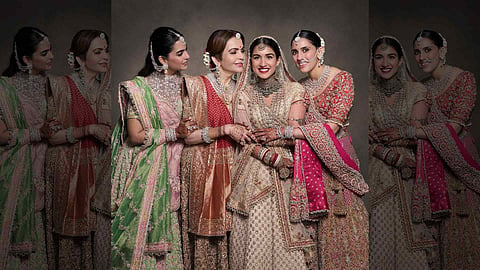

Whether it’s a Phulkari dupatta from Punjab, a Kanjeevaram saree from South India, a Bandhani or Gotta Patti lehenga choli from the Western region, or a Kalidar Phiran from Kashmir, traditional weaves have always been an intrinsic part of our wedding and festive wardrobes.
Over the past few years, bridal wear designers have begun to collaborate with Indian craftsmen and artisans to revive traditional weaving techniques for wedding wear. Popular names like Manish Malhotra and Sabyasachi have been at the forefront of the movement with their use of Indian handloom techniques in their collections. Rahul Mishra is also another prominent champion of the cause, with his collections putting the spotlight on Indian crafts and artisans.

At the recently concluded FDCI Manifest Wedding Weekend, designers like Anita Dongre and Anju Modi, too, showcased how handlooms are the next big thing in bridal wear trends for the upcoming wedding season with their respective collections. Labels like Asha Gautam and Shanti Banaras are also giving a contemporary twist to the traditional crafts to bridge the gap between ancient and modern.
On the occasion of National Handloom Day, we decided to take a deep dive into the rich world of Indian handlooms and their intrinsic connection to bridal wear in the country…
The history of handloom in India can be traced back to 3000 BC. There have been numerous records of India’s booming crafts industry by explorers from this time. The golden age for handloom, however, began with the patronage of Mughal emperors in the country. Weaves like Banarasi and Jamawar began to flourish during this period. Royals and nobles across the country had a taste for the rich and vibrant weaves that began to grow in different regions of the country.
Indian textile and crafts industry has a rich past but is mired with devastating losses, thanks to colonial rule and industrialisation. Many traditional crafts, especially popular in bridal wear, were lost or increasingly rare over the years.
When it comes to wedding wear, there are no wrong choices when it comes to handlooms. The painstaking care and towering legacy that each weaving technique brings to the table make these the perfect choice for any bride, groom, or wedding attendee’s wardrobe for the special day. For brides who are mindful of their style choices, here are a few weaving techniques that you can try for your wedding ensemble…
Originating from the Damascus region of the Middle East, it usually involves weaving a shiny satin fabric over a contrasting colour background. The pattern sequence always consisted of the weavers of the ethnicity, group, community and culture of the weavers. The weave pattern is usually light-coloured and reflects only during the daytime. It finds its usage mostly in Kanjeevaram, Banarasi and Pochampalli saris.
The wordaadain Hindi translates to diagonal. For fans of minimalistic style, the aada weave pattern in saris is usually floral trellis, geometric or a mix of both. You can find the aada weave of sarees in Banarasi, Ikkat sarees. Sagrika Rai, founder of Warp ‘n Weft, calls the aada weave pattern a saviour for all lovers of minimalistic elegance because the weave pattern features a non-complex simple geometric pattern created by two weavers, one working on the border while the other focuses on the body of the garment. This weave pattern features more age-old stripes and diagonals created with utmost meticulous precision.
The Baluchari weaving pattern originates from the Baluchar region of West Bengal. The weave pattern theme involves showcasing scenes from mythological stories like Ramayana and Mahabharata, floral motifs and the royal court. The threads used to make the weaves are usually gold and silken threads.
TheJamdaniweave originates from the city of (then) undivided Eastern Bengal. The weaving technique involves directly weaving onto the handloom without involving any weft technique. TheJamdaniweave uses real gold and silver threads to carve its intricate weave patterns. Designer Gautam Gupta, co-founder of Asha Gautam says, “The Jamdani weave pattern creates a distinct design and opacity against its nearly sheer base, which gives the overall outfit a scintillating, jaw-dropping effect”. We recently saw stunning examples of Jamdani weaves during the wedding of Anant Ambani and Radhika Merchant.
The Shikargah weave pattern involves a zari pattern to depict scenes from the hunting games. It usually features majestic tigers, fiery lions, triumphant elephants, golden deer, quirky parrots, and glorious peacocks and is adorned with ogival cartouches, leaf patterns, and floral arabesques. This particular weave pattern is primarily restricted to Banarasi sarees as it brings out the intrinsic beauty of the silk base of the ensemble in the most nuanced way. Gautam Gupta says that the silk used in Banarasi sarees is flexible and is feasible to be used in different yarns and the most delicate fabrics. Hence, this weaving technique is restricted to the Banarasi sarees.
The weave of the Northeastern states of India involves creating small intricate patterns dispersed over a large piece of cloth. The motifs are made only using the primary weft. It was brought to Gujarat from China by three brothers with the last name Choi and was named “Tran choi” meaning three choi brothers. The weaves are made using silk threads on satin pattern bases with small floral and paisley motifs dispersed evenly over the fabric.
While there’s still a long way to go for Indian handlooms to be restored back to their original glory days, there’s a fervour amongst designers and labels today that seems promising. Rimple and Harpreet’s designer Harpreet Narula says, “With increased awareness to support local businesses, public attention has shifted from mass-produced embroideries to more handmade items with artisanal value, such as weaves, embroideries, crocheting, macrame, hand-stitching, smocking techniques, and tucks which have gained significant attention to implemented in regular wear, but primarily bridal couture because it widens the scope to explore the rising need for bespoke fashion.”
While designers like Manish Malhotra and Rahul Mishra have championed the cause of craftsmen through their collections over the past few years, we saw how handlooms can make for stunning wedding or bridal wear at the newly crowned Wedding of the Century, AKA the Ambani wedding. The bride Radhika Merchant’s wardrobe for the wedding comprised stunning brocades and handlooms that would serve as inspiration for brides for years to come.
In an interview with Manifest recently, Warp ‘n Weft founder Sagrika Rai said, “Today’s brides prioritise their bridal wear considering how, when, and where they invest their money. They like to understand the origin and the ethics followed towards its creation, its repeat value and its timeless fashion quotient. They aim to be both chic and responsible with prudent choices.”
Designer Anita Dongre’s latest collection Raahi made a case for traditionally woven ensembles for brides at the FMWW 2024 with a special emphasis on Pichwai, Badla and Gota Patti from Rajasthan, Bandhani from Gujarat, and the traditional weaves from Banaras.
Brides are also re-wearing family heirloom saris that have been preserved for ages for their wedding ceremonies. More recently, Sonakshi Sinha wore her mother’s wedding sari for her ceremony.
Whether you’re going for a piece that has been passed down from generation in your family or opting to invest in something new, remember that there’s an Indian weaving technique for every kind of bride!