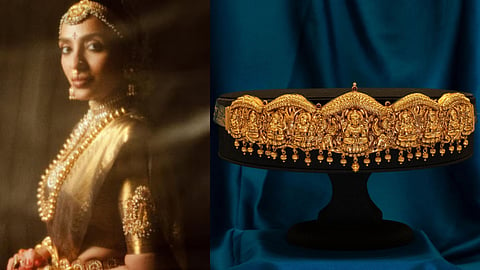

Long before Sobhita Dhulipala paired her rose gold kamarbandh with a Kanjeevaram silk sari at her nuptials, or Radhika Merchant donned a ball chain version with her bandhej lehenga choli for her Mameru ceremony, the divine apsaras were fabled to wear these elegant waistbands during their performances in Lord Indra’s celestial court. The word, originating from ancient Persia, became a common name for the delicate and luxurious adornment that symbolised femininity, fertility, protection, and grounding in ancient India. Made of gold, silver, and precious gems, the bejewelled belt can be traced back thousands of years, with mentions of the ‘mekhala’, [means a belt, girdle, or sword belt, used to secure the lower garment from 1500 BCE to 500 BCE. With great significance in wedding rituals among various South Asian cultures, the waist jewellery influenced many over the years—the British East India army, and Karl Lagerfeld alike.
On sculptures of Ganga depicted as a nati (dancer) at Vidarbha temple in Andhra Pradesh, with women undressing for a bath carved across the Rani Ki Vav stepwells in Gujarat, or worn by the late Maru-Gurjara-style Yakshi figurine in the Archaeological Museum of Bodhgaya, Bihar—the kamarbandh or patka is a common sight across ancient Indian fashion, with customisations based on profession, purpose, and perceived divinity.
Think floral buckles, layers of beaded tassels, and delicate embellishments that make for silhouette-defining jewellery that was bound to stick around. Through the labyrinth of cultures that the Indian subcontinent comprises, many primordial versions of the kamarbandh survived, often as part of performance art, such as Bharatanatyam and Kathakali, as well as bridal trousseaus. Of the 16 adornments essential for a bride, according to the Vedic texts, adorning the kamarbandh is of great importance. Believed to have been gifted to the Hindu goddess of sexuality, Rati, by Lakshmi, the goddess of wealth, to win over the god of love, Kamdev.

With the establishment of the Mughal Empire in 1526, Indian fashion saw a confluence of trends. Wool pompoms and pietra dura techniques did not overlook the unisex kamarbandh, dubbed tahband and katzeb by Mughal emperors Babur and Akbar. The waistbands for women were elegant and ornate, often featuring intricate embroidery, precious stones, and luxurious velvet or silk fabrics. French traveller François Bernier (1656-1668 CE) even wrote about “girdles with golden flowers” in his account of the Mughal court. Parallely, the kamarbandh remained an integral part of Rajput traditions, the kardhani or tagdi crafted from gold with Polki or Kundan work, commonly worn by royal brides. Traditional Marathi attire featured the kambar patta, while folk jewellery from Chhattisgarh had its version made of silver and metal alloys. The South Indian oddiyanam or vaddanam, a temple jewellery belt made of gold or silver and traditionally devoid of gemstones, was a staple wedding tradition in Tamil and Telugu families, which remains to this day.
“I remember my mother explaining how the kamarbandh connects women to the divine feminine,” says Puja Shah, Co-Founder and designer at Aurus Jewels. “Traditional Indian jewellery was often trusted to regulate and recharge. Kamarbandhs were also believed to empower fertility and align the sacral chakra,” she adds. In Kerala, the aranjanam (a waist chain) tied on a baby’s 28th day after birth is believed to promote healthy growth and ward off evil spirits. Adorned with motifs of elephants and peacocks, inspired by temple architecture, the bridal oddiyanam holds great cultural tenor. It symbolises femininity, fertility, protection, and marital status, much like their North Indian counterparts, influenced by Mughal and Rajputana styles. Puja, who has recently designed custom kamarbandhs for a number of brides, believes it is having a renaissance among modern Indian brides. “People love something that adds structure to flowy traditional outfits, and it is also an investment piece they can hold onto.”
Today, Indian couturiers—from Tarun Tahiliani to Sabyasachi—are revisiting the kamarbandh, with both legacy as well as niche jewellery brands chiming in. Paisley Pop, a Jammu and Kashmir-based luxury art jewellery store, offers delicate pieces in Polki and shell pearl work. Meanwhile, Mumbai-based Dilnaz Karbhary creates satin, hand-embroidered waist belts with feather trims. Tribe by Amrapali is for the wedding guest who wants to try on a kamarbandh before committing—their gold-plated alloy waistbelts with pearls and glass work are ideal for a first timer. But Bengaluru-based private jewellery designer, Ambar Deshpande, believes there is magic in incorporating heirloom jewellery with current sensibilities. “A lot of Indian jewels are extremely versatile—a tiara turns into a choker, and a layered necklace can double as a kamarbandh, for instance,” he says. “Heritage waist belts have a lot of potential for outfits beyond the lehenga or sari.”
A watersmeet of styles, paired with innovation, has caused a curious revival of the kamarbandh. Polki and Meenakari have merged with filigree and Kundan work to create contemporary versions of the accessory. Palak Shah, Founder and CEO of Ekaya Banaras, fell in love with them when she wore one to her cousin's wedding. “The bride’s side was from Coimbatore, and it was a perfect chance to pair my Kerala Kasavu sari with a golden kamarbandh”.
For Ekaya’s SS25 collection, she introduced pearl string waist jewellery in collaboration with Anāash by Gaure Monga—pieces that would have fit right into Chanel’s Paris-Bombay show held at Grand Palais in 2011. Celebrities such as Priyanka Chopra Jonas, who wore a diamond kamarbandh for her Hindu wedding ceremony in 2018, and Janhvi Kapoor, with her emerald-encrusted kamarbandh that she paired with a Manish Malhotra pattu pavadai for the Ambani wedding last year, have cemented their love for the timeless waist-cincher.
Today, the kamarbandh can be regal for the big day, while still being able to transition into something you can wear time and again.