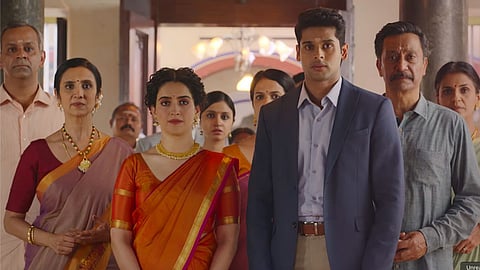

At a family lunch celebrating 47 years of my in-laws’ marriage, I watch my 65-year-old mother-in-law, Radhika Pathanjali, give her husband a knowing side-eye as he stifles a giggle, stealthily reaching for the basket of pappadams. She bursts into her signature, full-bodied laugh because she’s seen this play out countless times. She’s the gatekeeper of his nutrition—he gets his allotted four pieces.
No debates, no sneaky grabs for extra. I wonder what it takes to reach this unspoken ease and understanding after nearly five decades of marriage? Like many of her generation, her marriage was arranged swiftly and with little say in the matter.
“Our parents decided everything. The groom was asked if he was interested, but I wasn’t. Back then, horoscopes and family backgrounds dictated compatibility. If they didn’t align, we wouldn’t even meet,” she recalls.

While she briefly questioned why she hadn’t been consulted, she ultimately trusted her parents’ judgment. She acknowledges that their choice worked out, but credits much of their success to the man she married and the way he supported her.
You May Also Like: Matchmaker Geeta Khanna's Playbook For Finding Love In The Digital Age
While Pathanjali had little control over choosing her partner, she shaped the life they built together—their home, the values they passed on, and the way they raised their children. “I chose to stay home because I had kids early, but many women worked in banks and clerical jobs—a step up from our mothers’ time,” she notes. Over the years, arranged marriages in India have evolved. A study analysing marital trends from 1970 to 2012 found a decline in traditionally arranged marriages, with more women actively involved in selecting their partners.
Yet, many marriages still follow arranged conventions. Though there has been a shift toward individuals choosing their partners, the influence of family remains deeply ingrained in South Asian communities. In that setting, an arranged approach can be beneficial. For Chennai natives Lavanya Mohan, 36, a social media marketing head, and her husband, Suhrith Parthasarathy, 39, a lawyer, who are celebrating their 12th year together, their match began with an observant distant aunt who saw their shared interests and tipped off both mothers.
The digital age played its rightful part—Mohan, armed with Facebook, did her research before saying yes. “I wanted someone with a strong personality and diverse interests. And he had to be cute,” she laughs. A 2020 survey of over 3,700 respondents found that 69.2% of Gen Z in India preferred love marriages, compared to 62.3% of Millennials.
You May Also Like: The Viral ‘March Theory’ Predicts A Big Shakeup In Your Love Life
However, Mohan finds that a marriage’s success depends less on how it begins and more on long-term compatibility. She also dismisses the stereotype that arranged marriages are for people who “couldn’t date”. Instead, she views them as a pragmatic choice for serious commitment—one that eliminates situationships and general dating fatigue. “The upside of arranged marriages is strong family support, and shared cultural and economic backgrounds, so they’re already rooting for you both.” If binge-watching Indian Matchmaking has taught us anything, it’s that today’s arranged marriages leave plenty of room for personal choice.
“We got to know each other on Skype before formally involving our families—it was entirely our decision to move forward,” Mohan shares. “I’d recommend at least six months, or longer if needed, to truly understand one another.” This courtship timeline resonates with Bengaluru-based couple Gitanjali Dinesh, 35, and Manu Haridas Nair, 36, who work in analytics and marketing. The duo met through their parents and married seven years ago.
You May Also Like: How To Pamper The Women Around You The Way They Deserve
“My mom pushed me to go on dates while I was working in the States. When that didn’t happen and I moved back home, she started sending proposals. I planned to dodge Manu’s like I had others, but we connected instantly on text. He flew from Kochi to Bengaluru for our first lunch, which turned into dinner. By the end of the night, we made up our minds,” Dinesh reveals. She had full control over her decision, though her husband’s family followed a more traditional process of matching horoscopes before sending him the proposal. Forming a friendship first was essential—a space where both felt seen and understood, which ultimately became their foundation for a peaceful home. For 34-year-old Pooja Shah, an associate art lead at a beauty brand in Mumbai, the arranged route is simply another way to meet people.
“My parents only pass along basic details. Everything else is up to me.” As someone exploring both dating apps and arranged prospects currently, she finds that the people she meets through her parents tend to have more intentionality towards the same end goal. With family introductions, she prefers to let the other person take the lead initially. “You can learn a lot about someone’s vibe by the questions they ask, she says. “Unfortunately, many conversations are predictable—and sometimes a bit sexist. Yes, I am close to my siblings, and no, I don’t love cooking.”
You May Also Like: Gen Z Is Making Marriage Cool Again
She quickly brushes off these outdated perspectives, preferring to dive into broader, more abstract discussions. “It’s more important to know how someone thinks. You can never fully know a person, although you do know in your gut. After a point, marriage is a leap of faith.” Deeming the red and green flag approach too simplistic, Shah believes that what once felt like a dealbreaker can become easier to accept when seen through the lens of love. “My non-negotiables are that they have to be smarter than I am—and I don’t mean more educated— and communicate well. It wouldn’t hurt if they were good-looking either.” Ultimately, whether love or arranged, the true determinants of a lasting marriage seem to be agency, effort, and evolution. As Dinesh puts it, the format rarely matters in the long term “Marriages need nurturing. If partners are willing to put in the work, happiness can be within reach.
Eliminate the non-negotiables that could stop you from moving forward.
Setting and understanding each other’s career expectations.
Thoughts on children, if and when, Familial or existing financial obligations.
Comfort around living setup—nuclear or joint?
Understanding patterns and agency in a long-term relationship,
Managing joint finances
Every day's expectations in a joint setup
How larger decisions are made in the family indicates parenting and family influences in the future.
Personal preferences that can help seal the deal
Shared life goals—real estate ownership, travel style, children’s education
Common interests and skills
Shared responsibilities—contribution to cooking or home maintenance
Health, wellness habits, and dining preferences
Relationship expectations
Love languages
This story appears in Manifest India’s Issue 02. Subscribe here for more stories like this.