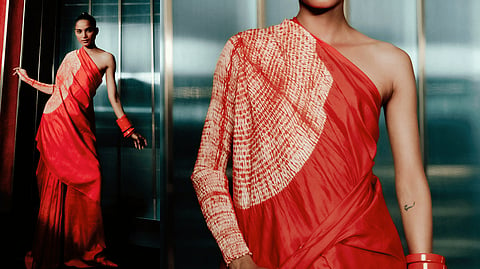
If you have found the love of your life over shared sustainable values and are planning to tie the knot, Studio Medium fits naturally into your wedding plans. Established in 2017, Studio Medium is loved by Sonam Kapoor Ahuja, Dia Mirza, and Kiran Rao, to name a few. Known for its artistically tie-dyed clothing and innovative hands-free saris that feature arm holes in their pallus... Studio Medim is renowned for its expertise in natural dyeing techniques and combining various Indian crafts, such as bandhani and jamdani, to create a fresh visual expression.
Whether you're choosing an outfit for the mehendi, haldi, or a post-ceremony dinner, the label offers options that balance comfort with considered design. Not just that, their vibrant patterns and pleated styles make a compelling argument for bohemian fashion with a colourful twist.
You May Also Like: Manifest Spotlight: Wedding Photographer 1Plus1 Studio
Ahead of the brand’s studio launch in Dhanmill, New Delhi, we caught up with Ridhi Jain, Founder and Creative Director, on what her new store entails, how this off-beat brand would make for an amazing option for the upcoming wedding season, and more.
Manifest: Tell us about your brand and journey.
Ridhi Jain: Our journey has been about discovering new relationships between textile, form and function-especially within the framework of traditional Indian drapes. Our work often sits at the intersection of craft and contemporary design, using traditional techniques to create garments that feel quietly radical. From our earliest experiments with thread waste to our current explorations in silhouette and structure, the ethos remains the same: to challenge what Indian clothing can look and feel like today.
M: Congratulations on your new store! Tell us more about it.
RJ: Our store in Delhi is an immersive space designed as an 'Ode to the Act of Making.' It brings together our seasonal collections, archive pieces, and special commissions in a quiet, textural environment. For us, the store isn’t just a retail space- it’s an invitation to experience Studio Medium as a world, not just a label.

M: What sets you apart from other labels in the space currently?
RJ: We are interested in creating clothes that hold intellectual as well as emotional value. Design is not just a surface pursuit for us—it begins with asking deeper questions about how garments are worn, how they move, how they participate in a woman's life. Our Handsfree saree, which reimagines the drape with function and ease in mind, is a good example of this. We're also deeply rooted in materiality, often working with pre-consumer waste or old textile traditions as a trend but as a core practice.
M: Tell us about your consumer base.
RJ: Many of them are women who move across different worlds- professional, creative, familial and want their clothing to reflect that sense of multiplicity. We’ve also seen a growing number of brides and families coming to us for wedding wear that feels personal and distinct from the usual bridal vernacular. They are curious and not afraid to stand out.
You May Also Like: Manifest Spotlight: Bridal Sari Stylist Dolly Jain
M: How do you cater to the wedding space?
RJ: We approach wedding wear the same way we approach everything at Studio Medium: with a sense of intention. Instead of over-embellishment, we offer brides garments that carry a quiet drama, whether it’s through silhouette, textile, or a meaningful technique.
M: What type of bride should come to you?
RJ: The kind who knows that less can say more. Someone who’s looking for timelessness but also wants to feel like themselves on their wedding day. Our brides are often deeply involved in the process...they care about how something is made and why.
You May Also Like: Designer Spotlight: Siddhartha Bansal’s Bohemian Occasionwear
M: Tell us about your hands-free saree.
RJ: The Handsfree sari is our response to curiosity and forever asking ourselves, what if? It features a restructured pallu with an integrated sleeve opening, allowing the sari to be worn without constant adjustment. It rethinks the sari not as a fixed format, but as a living garment and something that adapts to the needs of contemporary life while retaining the elegance of the original.
M: How does this design translate into the wedding space?
RJ: It offers brides- and especially wedding guests- freedom. The handsfree saree can be a stunning sangeet or cocktail look, or even a modern take on bridal wear for someone who wants to move with ease. It brings a sense of lightness to an occasion that’s often weighed down by tradition and fabric, quite literally.
M: When should a bride getting married in July 2025 ideally come to you?
RJ: We’d recommend starting the conversation by January or February 2025. This gives us enough time to work collaboratively on customisations, fittings and any textile-specific processes that require more lead time.
M: What were some of the major wedding fashion trends you witnessed this year?
RJ: There’s been a definite shift towards modularity and movement. Brides are embracing separates, lighter drapes, and silhouettes that let them participate fully in their celebration.
M: Do you customise designs? If yes, how much time does it typically take?
RJ: Yes, we do. Customisation timelines can range from 4 to 10 weeks depending on the complexity of the garment and the level of textile work involved. We try to build in time for fittings and feedback so that the final piece feels entirely aligned with the wearer.