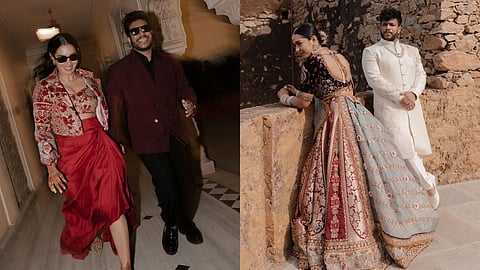

For college sweethearts Anupama Jethalia and Abhinav Saha, their love story began with the simple joys: canteen conversations, shared chocolates, endless cups of coffee, and two students trying to figure out life in Jaipur. She was a Marwari girl. He was a Bengali boy. Their worlds looked different on paper, but over the years, they discovered that the things that mattered most felt remarkably the same.
Fourteen years later, after navigating different cities, careers, milestones, and the countless versions of themselves that adulthood demands, they found themselves back where it all began. Jaipur wasn't just another wedding destination. It was home to their beginning. Returning to the city to get married felt less like a choice and more like destiny quietly completing a circle.

Set against the timeless charm of Mundota Fort & Palace, their wedding unfolded as a celebration of everything that had shaped them over the last decade and a half. There was a female pundit leading the ceremony, a conscious choice that reflected their values. Anupama walked beneath a handprinted chadar adorned with the blessings of her family. Live sitar music floated through the air during the pheras. Bengali and Marwari traditions met effortlessly throughout the celebrations, not as separate identities but as one shared story.
The festivities each carried their own distinct mood. The welcome evening was warm and emotional, filled with speeches and family memories. A sun-drenched poolside haldi brought softness and intimacy. The sangeet embraced drama with vintage musical influences and statement décor. Then came the wedding day itself, a striking all-white setting beneath cascading floral chandeliers that felt suspended somewhere between dream and reality.
The personal touches were everywhere. Invitations featured Bengali and Hindi scripts. The menu paired Rajasthani favourites with Bengali sweets. Traditional folk performances sat comfortably alongside classical music. Anupama's wedding bangles blended Rajasthani chooda with Bengali shaka-pola, while her bridal entry incorporated both a Marwari family blessing ritual and the Bengali tradition of paan patta.
Captured by photographer Manvi Gandotra of 1Plus1 Studio, the wedding wasn't driven by trends or spectacle. Instead, it focused on emotion, memory, and the quiet significance of two families coming together.
"We wanted the wedding to feel like an extension of us rather than a recreation of something we'd seen online," says Anupama.
And perhaps that is what made this celebration so memorable. It wasn't just about a wedding day. It was about honouring fourteen years of growing up together, embracing two cultures with equal love, and returning to the city where it all began.
Manifest: How did you two meet?
Anupama (A): We met 14 years ago in college, over canteen conversations, shared chocolates, and far too many hours at the campus CCD.
Abhinav (AB): We had just entered college for our undergraduate years when we met in the canteen. Little did we know that hanging out with friends, sharing a Milky Bar chocolate, and spending hours at the campus Cafe Coffee Day would eventually lead us here.
M: When did you know they were "the one"?
A: At first, I genuinely thought we were complete opposites. His energy was a little too much for me. But over time, I realised that was exactly what made life more fun. As for knowing he was "the one", let's just say he figured it out much before I did. I was busy playing it cool.
Ab: For me, it happened very early. She became "the one" within the first month of us dating. It was stamped in my heart during winter vacation when I couldn't wait to get back to college just so I could spend time with her.
What's a memory from your early days together that you both treasure?
A: The simple memories stand out the most. Spending entire afternoons on campus with nowhere to be, talking about everything and nothing, watching movies, and stretching one coffee into hours of conversation.
Ab: We spent hours during college breaks just chatting, watching movies, and hanging out at Cafe Coffee Day.
Tell us about the proposal.
A: For years, I teased Abhinav that he would never be able to surprise me. We spent too much time together for him to pull it off. I was completely wrong. He secretly designed the ring, spoke to my father for his blessing, and planned everything without me suspecting a thing.
Ab: The challenge was that Anupama prefers quiet, intimate moments and she works in the jewellery industry. Buying a ring for her felt like detective work. I overheard her mentioning a particular ring style she liked, secretly got it designed, used my mother's phone for all payments, and even asked her father for his blessings. I booked a villa in Udaipur and convinced her siblings to plan a family outing there. She walked into the setup completely unaware, which made it all worth it.
What kind of wedding did you envision?
Ab: Honestly, we initially imagined a small wedding with about 80 to 100 close family members and friends, probably somewhere by the beach or in the hills. Our parents had bigger plans, and now we're incredibly glad they did.
Did you face any challenges while planning?
A: The biggest challenge wasn't the logistics. It was making hundreds of tiny decisions together. Thankfully, after 14 years, we had plenty of practice understanding each other's quirks and priorities.
Ab: Bringing together details from both Bengali and Rajasthani cultures required a lot of late nights, mood boards, and discussions.
How involved were you in the planning?
A: Very involved, probably more than we should have been. We wanted a hand in everything, from venues and artists to invitations, décor, videos, and guest experiences.
Ab: We were involved in absolutely everything. Venue selection, event planning, artists, invitations, save-the-date videos. It was all us.
What influenced your wedding aesthetic?
A: We consciously avoided following trends. Most of our inspiration came from our personalities, shared experiences, and things we genuinely loved.
Ab: We wanted to find our own voice instead of being influenced by what everyone else was doing.
Why did you choose Mundota Fort & Palace?
A: It actually started with Abhinav's mother suggesting Jaipur because of its significance in our story. After several site visits, Mundota felt perfect. It had history, character, and room for all our ideas.
Ab: Since Jaipur played such an important role in our relationship, choosing the city felt natural. Mundota Fort & Palace made everyone happy the moment we saw it.
Tell us about your wedding outfits.
A: I knew early on that I wanted Banarasi elements in my bridal look as a nod to my Bengali husband. My wedding lehenga eventually became the perfect blend of both sides of my story.
Ab: I trusted Anupama's taste completely. I wanted something elegant that suited the venue and theme while still feeling relaxed and true to my personal style.
Which ceremony was most meaningful to you?
A: The welcome dinner. It was the first time all our favourite people were together in one place, celebrating our journey before the wedding festivities truly began.
Ab: The wedding ceremony itself. After losing my father, my mother has been everything to me. It was important that she sat beside me during the ceremony. We also specifically chose a female pundit because we wanted to challenge traditional gender roles while creating a meaningful experience.
What personal touches did you include?
A: There were so many. Bengali and Hindi scripts appeared throughout the invitations and décor. The food combined both cultures. My wedding bangles merged traditional Rajasthani chooda with Bengali shaka-pola. We even chose each other's wedding perfumes. One of the most emotional moments was walking beneath a chadar covered in my family's handprints.
Ab: We brought together countless elements from both cultures. Bengali scripts, Rajasthani food, Bengali sweets, folk dance, classical music, dhuti-panjabis, and Rajasthani bandhani pagdis.
Did you incorporate family traditions?
A: Absolutely. We also reimagined certain traditions to make them feel more inclusive. One Marwari custom became a grand Rajasthani lunch for all our guests rather than only the groom's family.
Ab: We included the Bengali ulu sound during the pheras, which symbolises blessings and new beginnings.
What went through your mind when you first saw each other at the altar?
A: Our 18-year-old selves would be very proud of us.
Ab: I remember thinking she looked absolutely ethereal. And that after all these years, we were finally making it official.
What was your favourite moment from the wedding day?
Ab: We had planned a first-look shoot before the ceremony so we could spend a little time together. Standing there, looking down at the venue, seeing our families, friends, and everything that had come together for us, felt surreal.
Was there a behind-the-scenes moment you'll never forget?
Ab: On the final night, we snuck into our best friend Kruti's room because she was leaving for the US the next day. The three of us hugged and cried together. It felt like reliving our final day of college.
What advice would you give other couples planning a wedding?
A: Talk. About everything. The exciting parts, the stressful parts, and the things that matter to each of you.
Ab: Plan together. Don't leave one person carrying the entire load. Listen, communicate, and make decisions as a team.
What are you most looking forward to in married life?
A and Ab: Growing old together. Adopting a dog. Buying a house in the hills. Continuing to discover new experiences, but doing it all side by side.